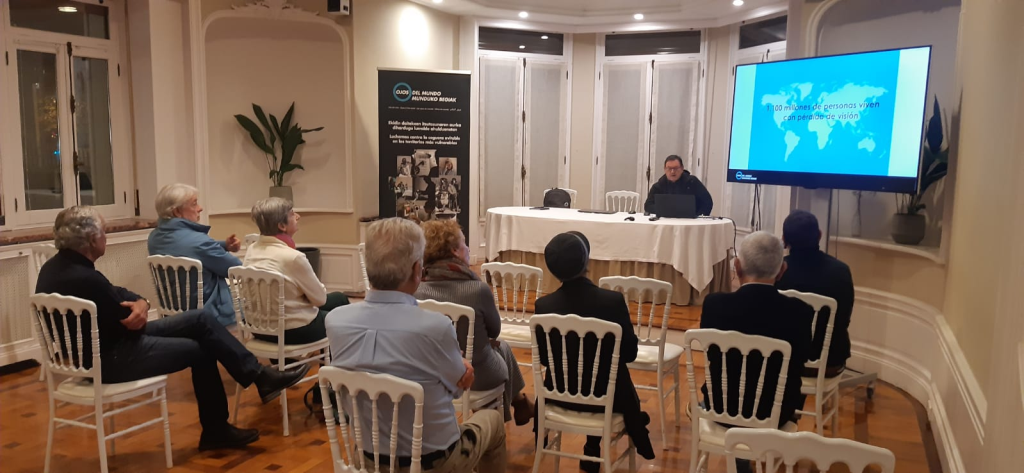
On 13 December 2023, the Eyes of the world Foundation organised a talk on universal eye health at the Official Medical Association of Navarre for registered doctors, which was also attended by other interested people.
 The aim of this session was to highlight the global challenge of achieving universal access to health, including eye health, and therefore Dr. Andrés Müller-Thyssen, ophthalmologist and trustee of the Foundation, presented the SDGs (Sustainable Development Goals) and the 2030 agenda, the goals and measures that each of the goals establish to promote positive change in society and the planet and their link to eye health.
Specifically, Dr Müller-Thyssen explained how vision enables children to access education and avoid school failure, working-age adults to get and keep a job, and older people to stay connected to the economic and social network of their communities.
Through the World Vision Report, the World Health Organization (WHO) recognises the important contribution of vision to the SDGs, highlighting the close links between eye health and virtually all major development issues:
Within eye care, strengthening health systems is essential to improve eye health and reach the populations most in need, leaving no one behind.
The second part of the presentation, given by Alfonso Noboa, delegate of the Eyes of the world Foundation/Munduko begiak in Navarra, focused on Universal Health Coverage (UHC), which implies that all people have access to the health services they need, when and where they need them, without having to suffer financial hardship to access them. UHC is a global priority for WHO and at the heart of the health-related Sustainable Development Goals.
WHO’s strategy for achieving UHC is to implement integrated, people-centred health services. This means putting the overall needs of people and communities, not just diseases, at the centre of health systems, and empowering people to take a more active role in their own health.
The WHO has made it clear that Universal Health Coverage cannot be Universal Health Coverage if eye care is not affordable, accessible and of high quality.
The global commitments to eye health and universal health coverage are:
- UN Political Declaration UHC.
- World Health Assembly Resolution on people-centred integration of eye care.
- World Health Assembly Global Goals on Eye Health.
Precisely, the sustainability of eye care in the territories where Eyes of the world/Munduko begiak has projects underway and the compulsory payment (except in cases of destitution) for some interventions were some of the questions that arose among the conference attendees during the interesting colloquium that followed. In this sense, it was revealing to become aware of the impact of cataract operations, considered by the WHO to be the surgical intervention with the highest cost/benefit result of all those that can be performed.
Another of the subjects dealt with by Alfonso Noboa in his speech was the participation of the Eyes of the world Foundation/Munduko begiak in the IAPB (The International Agency for the Prevention of Blindness). This is the global alliance for the eye health sector, which brings together more than 150 organisations in over 100 countries that work together for a world where all people have universal access to eye care. Specifically, the Foundation’s delegate shared the challenges that the IAPB has set for the coming years in the framework of the 2030 IN SIGHT strategy and its relationship with the SDGs.
Globally, 1.1 billion people live with the consequences of vision loss, mainly because they do not have access to eye care services and assistive products. Most people affected by vision loss live in low- and middle-income settings and vision loss is due to preventable causes. Women and girls, ageing populations and the most vulnerable are disproportionately affected by vision loss. If left unchanged, this figure will increase to 1.8 billion people by 2050.
The strategy (Sight 2030 Strategy – Sight 2030 Summary) offers a new approach to eye health in line with the UN 2030 Agenda for Sustainable Development.
In summary, the talk presented the work of Eyes of the world/Munduko begiak, which is a member of the IAPB Advisory Council, in line with the SDGs and suggested that all members interested in contributing to the Foundation’s mission can participate in the activities aimed at guaranteeing access to eye care services in the territories where the organisation has projects underway.
To find out more about the Foundation’s activities, visit the Eyes of the world website and subscribe to our quarterly newsletter.